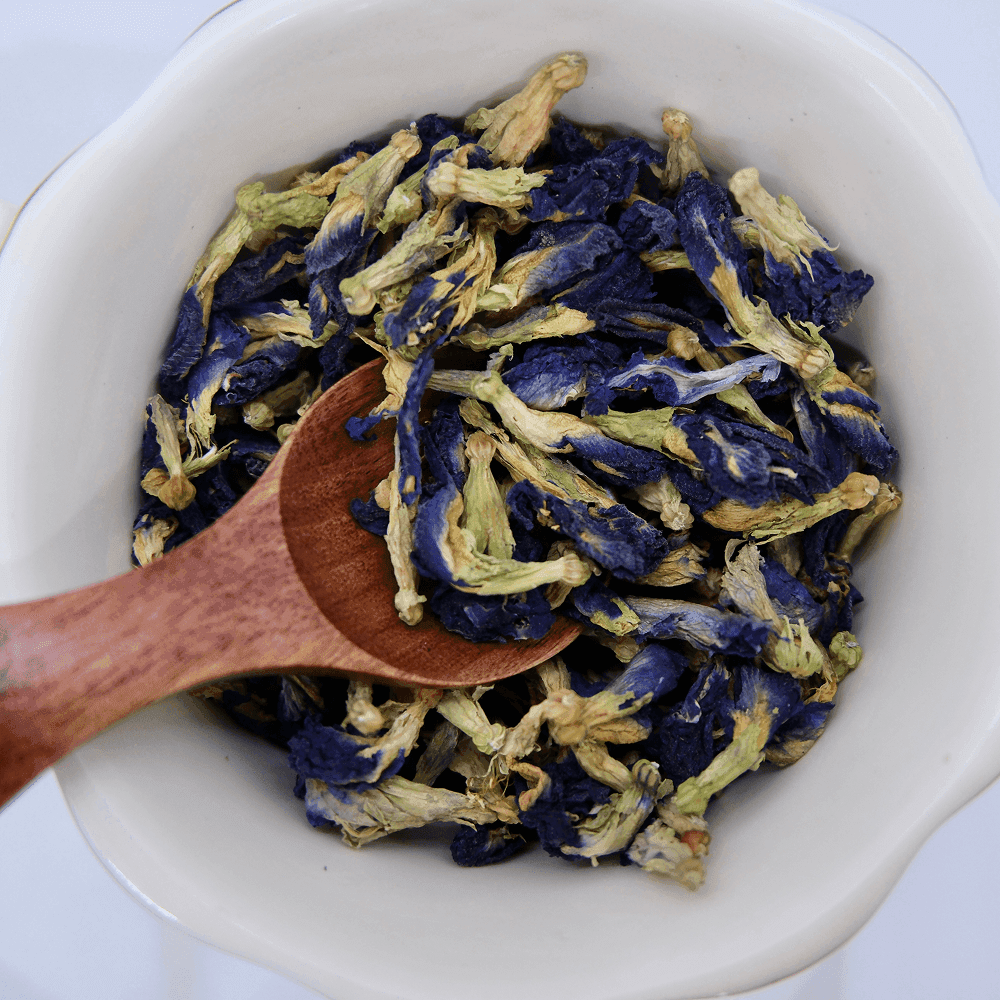
Butterfly pea is the only tea we stock that people photograph before they taste it. Brewed on its own it is an almost unreasonable cobalt blue — not blue-ish, not blue-grey, but the colour of ink. Add a squeeze of lemon and it turns violet in front of you, in about a second.
Clitoria ternatea is a climbing legume — genuinely a pea, related to the ones you eat — native to tropical Asia and grown across Thailand, Malaysia, Vietnam and Nepal. The flowers are a vivid deep blue with a pale throat, and they are picked and dried whole.
It has been used as a food colouring far longer than it has been sold as tea. In Malaysia the flowers colour the rice in nasi kerabu; in Thailand nam dok anchan is a sweetened iced butterfly pea drink sold on the street; across the region it tints rice cakes, custards and kaya. Drinking it is simply the most direct use of a remarkable dye plant.
| Butterfly pea tea | In short |
|---|---|
| Caffeine | None |
| Water | 90°C, just off the boil |
| Steep | 3 minutes, 1.5 teaspoons per 150ml |
| Tastes like | Mild, faintly earthy; a light green tea without bitterness |
| Best for | Colour-changing lemonade, iced drinks, blending |
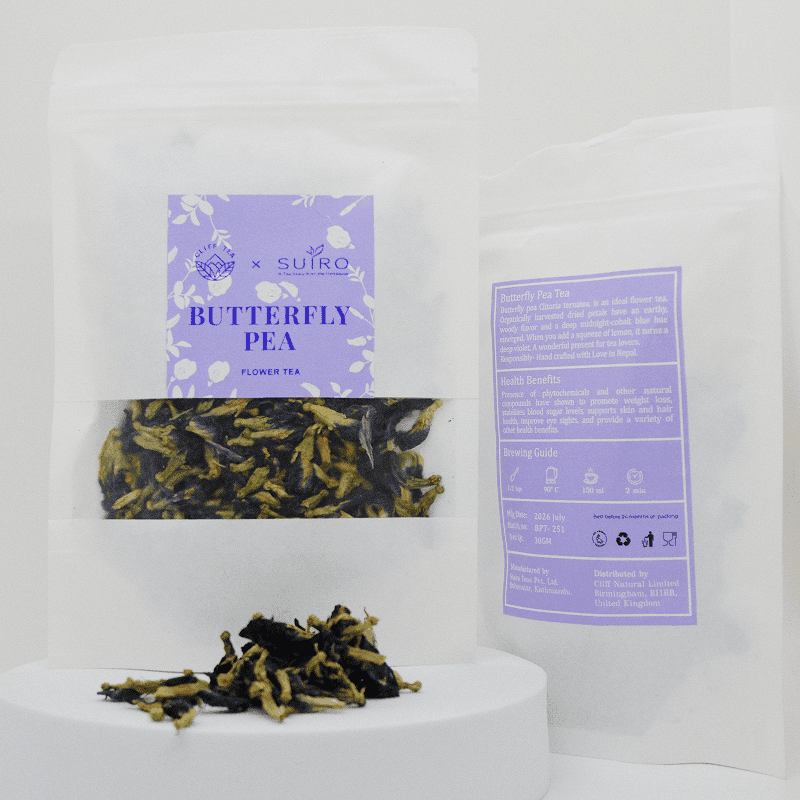
| Our pack | 30g pouch, whole flowers |
Why you'll love it
- A natural blue that nothing else can match. No colouring, no additive — the blue is the flower. It is the most reliable way we know to make a drink that people react to.
- It changes colour in the glass. Add citrus and it shifts to violet, then magenta. Done at the table it is genuinely delightful, and children find it close to magic.
- Rich in antioxidants. The blue comes from ternatins, an unusually elaborate group of anthocyanins — the same broad family of plant pigments found in blackcurrants and hibiscus.
- Naturally caffeine-free. A legume flower, not a true tea, so there is no caffeine at any point and no reason to avoid it in the evening.
- Very mild and easy to drink. Soft and faintly earthy — a little like a very light green tea without the astringency. Nobody finds it too strong.
- Endlessly useful in the kitchen. It colours rice, icing, cocktails and lemonade without changing how any of them taste.
Why it changes colour
Straightforward pH chemistry, and worth understanding because it lets you control the result. Anthocyanins change structure depending on how acidic their surroundings are, and each structure reflects light differently. Plain water is roughly neutral and the pigment reads deep blue. Add lemon or lime and the acidity turns it violet, then magenta-pink as you add more. Tonic water and sparkling wine are mildly acidic, so they give you purple. A pinch of bicarbonate of soda pushes it the other way, to green-teal.
It is the same principle as the red cabbage indicator from school chemistry, which is why butterfly pea is a genuinely good way to show a child what pH means.
How to brew butterfly pea tea
Two methods, depending on whether you are drinking it or using it as a colour base.
As a cup of tea
- 1
Use 1.5 teaspoons per 150ml
The figures on our pack, from the producer. The flowers are light and airy, so a teaspoon weighs much less than it looks.
- 2
Water at 90°C
Just off the boil rather than a rolling boil. Boil the kettle and let it stand a minute.
- 3
Steep three minutes
Shorter than you might expect. The colour arrives quickly, and a longer steep mostly adds earthiness rather than depth.
- 4
Strain and serve
Hot or over ice. Caffeine-free, so the time of day is entirely up to you.
As a colour base
For lemonade, cocktails or anything you want vividly blue, brew it much stronger — roughly a tablespoon of flowers in 250ml — steep longer, then cool completely before use. The concentrate keeps a couple of days in the fridge in a sealed jar. Always add the citrus at the table: the transformation is the whole point, and it only happens once.
Different ways to drink it
- Colour-changing lemonade. Cold butterfly pea over ice, lemonade poured in at the table. The single best use of this flower and reliably astonishing to anyone who has not seen it before.
- Gin and tonic. Blue concentrate in the glass, tonic poured on top — the tonic's acidity does the work. An excellent party trick with no effort behind it.
- Layered iced drinks. Sweetened concentrate is denser than plain water, so it sits at the bottom of the glass and the layers hold long enough to photograph.
- Iced with lemongrass and honey. Closest to the Thai street version, and genuinely refreshing rather than just pretty.
- Butterfly pea ice cubes. Freeze the concentrate and drop the cubes into lemonade for a slow colour change as they melt.
- In rice and baking. Steep the flowers in the cooking water for pale blue rice, or use the concentrate in icing and custards. The traditional use, and it adds colour with no flavour penalty.
- Hot, before bed. Caffeine-free and very mild, which makes it an easy last drink of the day.
Blending butterfly pea
Because it tastes of so little, butterfly pea is one of the easiest things to blend — it contributes colour and almost no flavour, so whatever you put with it stays firmly in charge.
- With lemongrass — citrus notes with a blue cup, and lemongrass is acidic enough to start nudging the colour towards violet.
- With chamomile or lavender — a soft, floral evening cup. Blue Calm Tea does exactly this blend for you, putting butterfly pea with lavender and chamomile.
- With hibiscus — hibiscus is acidic, so the two together give you a deep purple rather than blue or red, plus real tartness. Worth doing simply to watch it happen.
- With Beauty Blend — its jasmine supplies the aroma, butterfly pea supplies the colour. A very pretty combination.
- With mint and lime — the mojito approach, without the rum unless you want it.
Good to know
- Storage. Airtight, dark and dry, and be stricter about the light than you would with other teas — light is what dulls the blue. A tin rather than a clear jar.
- What is in the pack. Whole dried butterfly pea flowers, 30g, from Nepal. Nothing else — no flavouring, no colouring.
- It will not stain like hibiscus, but concentrate is still concentrate. Rinse the jug.
- Safety. Butterfly pea is treated as a food across Southeast Asia and is generally considered safe in normal amounts. As with any new floral infusion, if you are pregnant or breastfeeding, taking regular medication or managing a health condition, check with your GP or pharmacist first.